Rising Water at Big Lake and the Sturgeon River
by Kevin Aschim, BLESS Vice President
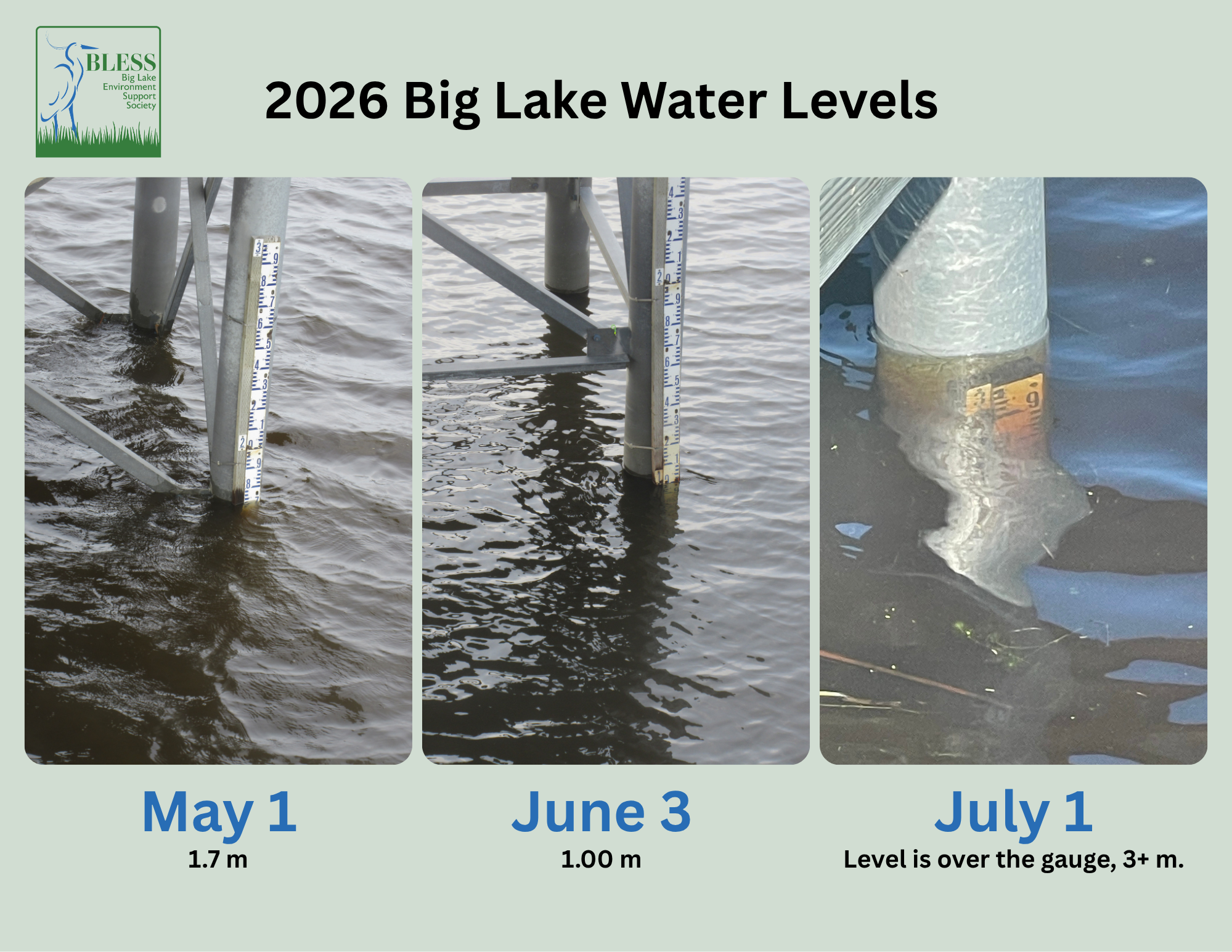
Anyone who has visited Lois Hole Centennial Provincial Park recently will have noticed a dramatic change in Big Lake. From the BLESS viewing platform, and from Ray Gibbon Drive, it is clear that the lake is much larger than it has been in recent years. Water has pushed well beyond its more familiar margins, flooding low-lying shoreline areas, wet meadows, and portions of the surrounding landscape.
The change is especially visible south of Meadowview Drive, where flooding has moved into agricultural lands. This area has been identified for future designation as an environmental reserve, and recent events show why that kind of land-use protection matters. Low-lying lands around Big Lake and the Sturgeon River are part of a larger natural system. They store water, slow runoff, buffer floods, support wildlife, and provide room for the lake and river to expand during wet periods.
While high water can create inconvenience and concern, it is also part of the natural rhythm of large wetland systems. Big Lake is a shallow, dynamic wetland-lake complex connected to the Sturgeon River, surrounding marshes, wet meadows, agricultural lands, urban areas and seasonal drainage patterns. In wet years, the lake expands. In dry years, it retreats. These changes shape habitat, water quality, vegetation, and wildlife use.
Rising water can affect nesting ducks and geese, especially when water levels rise after nests have already been established.
Canada geese often nest on muskrat houses, small islands, shoreline hummocks, raised patches in marsh vegetation, and other slightly elevated sites. If water rises quickly during the nesting period, some of these nests can be flooded or abandoned.
Dabbling ducks such as mallards, teal, gadwall, shovelers, and pintails often nest in grass, sedge, and other cover near wetlands. Nests close to the shoreline or in low wet meadows may be vulnerable if water moves into those areas. Nests farther back from the water are less likely to be affected.
For species that nest in emergent marsh vegetation such as red winged blackbirds and sedge wrens, the effect can be mixed. Higher water may create more flooded marsh habitat, which can be useful for some birds. But if water levels rise too quickly, nests built in cattails, bulrushes, or other vegetation can be swamped before eggs hatch.
Timing matters because if higher water arrives before birds choose nesting sites, many birds can adjust. If water rises quickly after nests are built, some nesting losses can occur. Stable water levels during the nesting period are generally best for successful hatching.
In recent years, Big Lake and the Sturgeon River have experienced extremely poor water quality conditions. These have included very high pH, elevated ammonium, ammonia and phosphorus, heavy algal growth, and hypereutrophic conditions. Hypereutrophic means the water is overloaded with nutrients, often leading to excessive algae, low oxygen conditions, odours, fish stress, and degraded habitat.
Additional fresh water moving through the system can help dilute and flush out water that has become stagnant, nutrient-rich, and chemically stressful. Higher inflows and expanded water movement can push older, poorer-quality water through the lake and river system and replace it with cleaner, fresher water. This does not solve all water quality problems, and it does not remove the need to reduce nutrient inputs from the watershed. But it can provide important relief after several years of extreme conditions.
The current high water is also a reminder that Big Lake and the Sturgeon River need room to move. Flooded fields, wet meadows, marsh edges, and shoreline transitions are not wasted spaces. They are part of the ecological infrastructure of the watershed.
These lands help absorb water during wet periods and release it more slowly over time. They provide habitat for birds, amphibians, insects, mammals, and aquatic life. They also act as buffers between developed areas and the lake. Protecting low-lying lands around Big Lake, including lands south of Meadowview Drive is about respecting the natural floodplain and wetland system that supports the lake itself.
The rising water at Big Lake and along the Sturgeon River brings both challenges and benefits. Some waterfowl nests may be lost where water rises into nesting areas. Trails, shorelines, fields, and access points may be affected. At the same time, the lake is receiving a much-needed influx of water after several years of poor water quality and extreme nutrient stress.
This is why long-term monitoring is so important. We need to understand how water levels, nutrients, pH, ammonium, phosphorus, algae, vegetation, and wildlife populations respond over time. Big Lake is a living system, and its health depends on both natural water cycles and the choices we make throughout the watershed.
For now, the expanded lake is a powerful reminder of what Big Lake is: not just a lake, not just a park, and not just a scenic view from the platform, but a vast and dynamic wetland system that continues to shape the landscape around it.
Edit:
July 2, 2026
Levels have risen over 2 meters in June alone, and are still rising! This is unprecedented in the history of the region since written records began being kept.